Signs Your Foundation Is Failing
Sticking doors, drywall cracks, uneven floors? Learn the early warning signs of foundation failure in Wichita homes and when to call for an inspection.
You know how a small draft near a window suddenly turns into a major energy bill increase during a Kansas winter. The same hidden escalation happens right beneath your feet.
A foundation rarely fails all at once. It sends subtle warning signs for months or years first.
Most homeowners in south-central Kansas see these signs of foundation problems without recognizing what they actually mean. We see this frequently during our daily inspections. The dividing line between a cosmetic patch and a major structural fix is usually just a matter of time.
Our team ranks these seven specific red flags based on the urgency they require. Catching these foundation failure signs early gives you control over the situation.
If any of these sound like your home, a free on-site inspection tells you quickly whether the movement is active or historic.
Let us look at the details.
1. Stair-step cracks in brick veneer
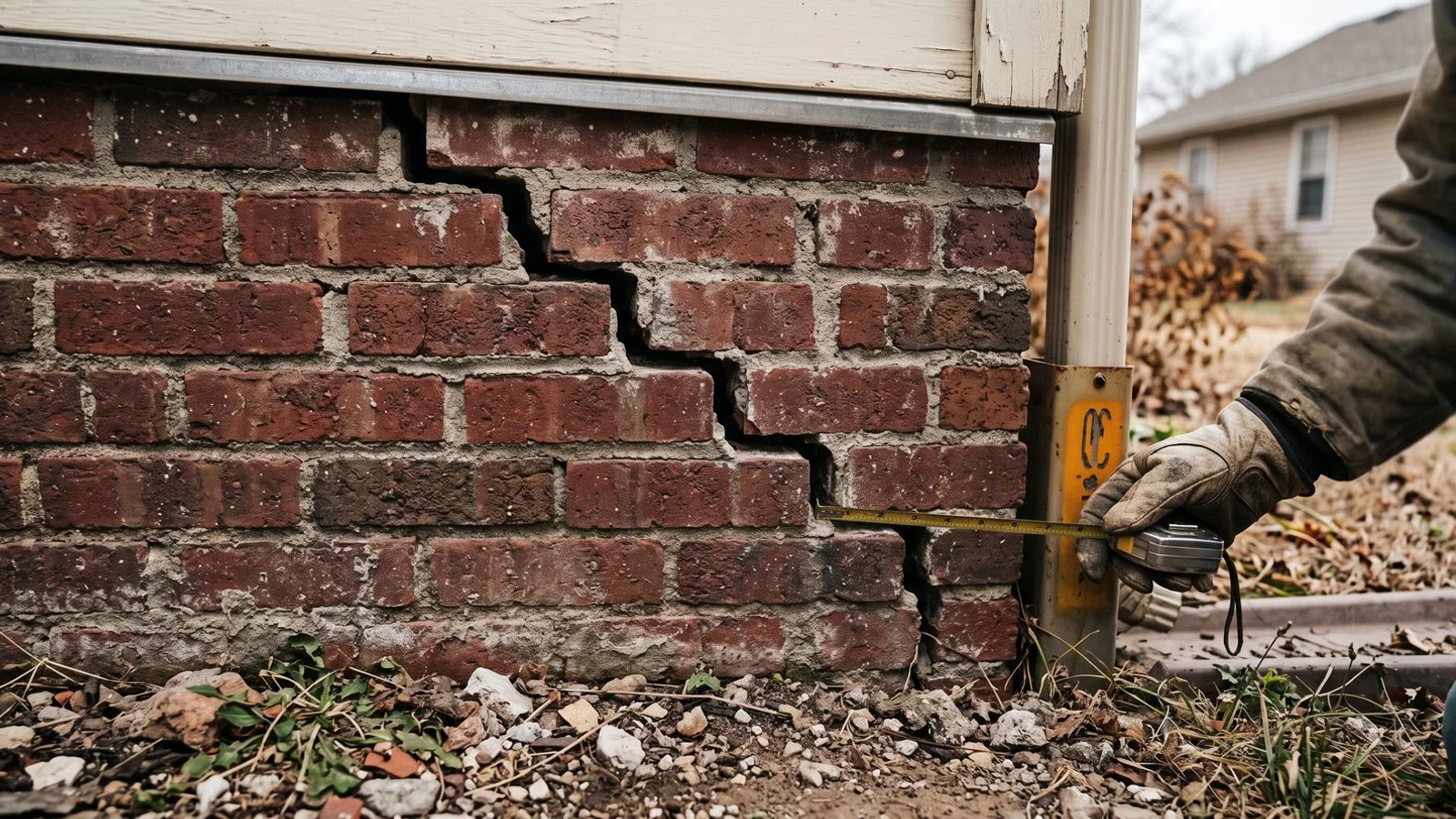
A classic visual cue is a crack that steps up through the mortar joints at a diagonal. This usually happens near a corner or above a door or window opening. Stair-step cracks actually track how the wall is separating. The direction of the step points directly toward where the foundation has moved or settled.
Hairline stair-step cracks near new construction are sometimes just cosmetic settling. Widening stair-step cracks that reopen after patching are structural issues that need attention. We look for cracks that exceed one-quarter inch in width. That size indicates active movement requiring more than just a mortar patch.
Here are the specific locations to inspect around a stair-step crack:
- Mortar joints near the ground level at the corners of your house.
- The brickwork directly above any load-bearing garage doors.
- Areas around window frames where the caulk line has suddenly stretched.
- Exterior walls facing the direction of downhill slopes in your yard.
2. Drywall cracks that keep coming back
Not all drywall cracks point to a sinking house. Some are simple seasonal humidity changes affecting the wood framing. The ones that matter show a distinct and repeating pattern.
We know that soils in south-central Kansas swell when wet and shrink when dry. This constant heaving puts immense pressure on your home. The expanding soil pushes the foundation up, and the drying soil lets it drop.
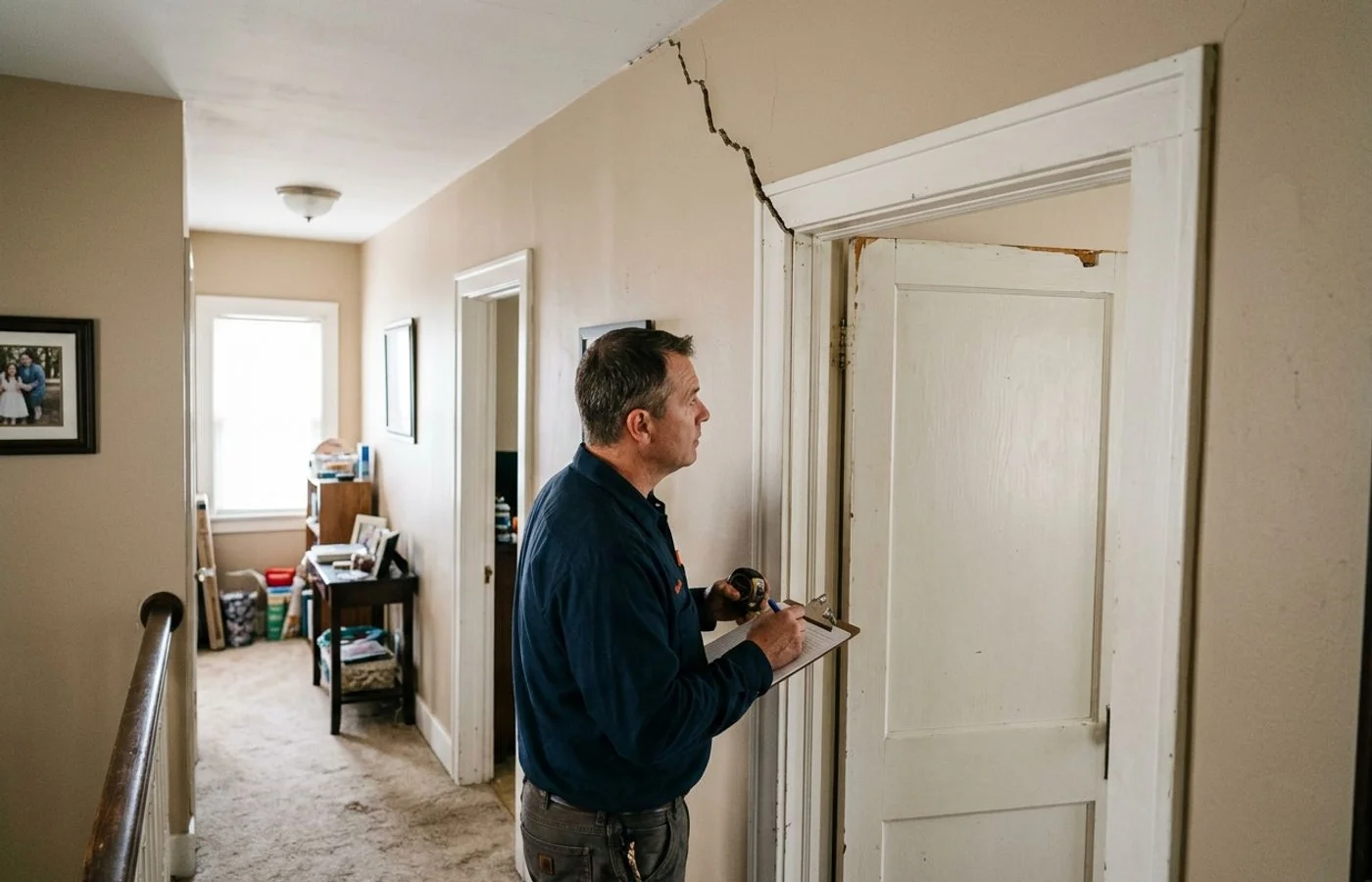
You can identify structural drywall cracks by looking for a few specific behaviors. Together, this pattern usually means the foundation is moving underneath and racking the wall framing above.
| Crack Characteristic | Seasonal Movement | Structural Movement |
|---|---|---|
| Location | Mid-wall or near ceiling seams | Diagonally up from door and window corners |
| Recurrence | Stays closed after patching | Reappears quickly after you patch and paint |
| Distribution | Isolated to one room | Shows up on multiple walls simultaneously |
| Size | Remains a thin hairline | Widens visibly over a period of months |
3. Sticking doors and windows
Foundation movement racks the wooden frames of your house completely out of square. Interior doors that used to close cleanly start to drag at the top edge. Sometimes they fail to latch at all because the strike plate no longer aligns.
Sticking windows and doors are clear signs of foundation problems that require attention. We use a standard framing square to check the corners of sticking doors during inspections. Even a shift of just one-eighth of an inch in the frame is enough to make a door bind tight against the jamb.
When this shows up in several rooms at the same time, that is the foundation talking. It becomes especially obvious seasonally during periods of heavy rain or severe drought.
If you are experiencing binding doors, check these highly vulnerable areas first:
- Exterior doors located on load-bearing walls.
- Heavy front entry doors with sidelights.
- Large, double-hung windows on the main level.
- Interior doors positioned directly above the main center beam in the basement.
4. Uneven or sloping floors
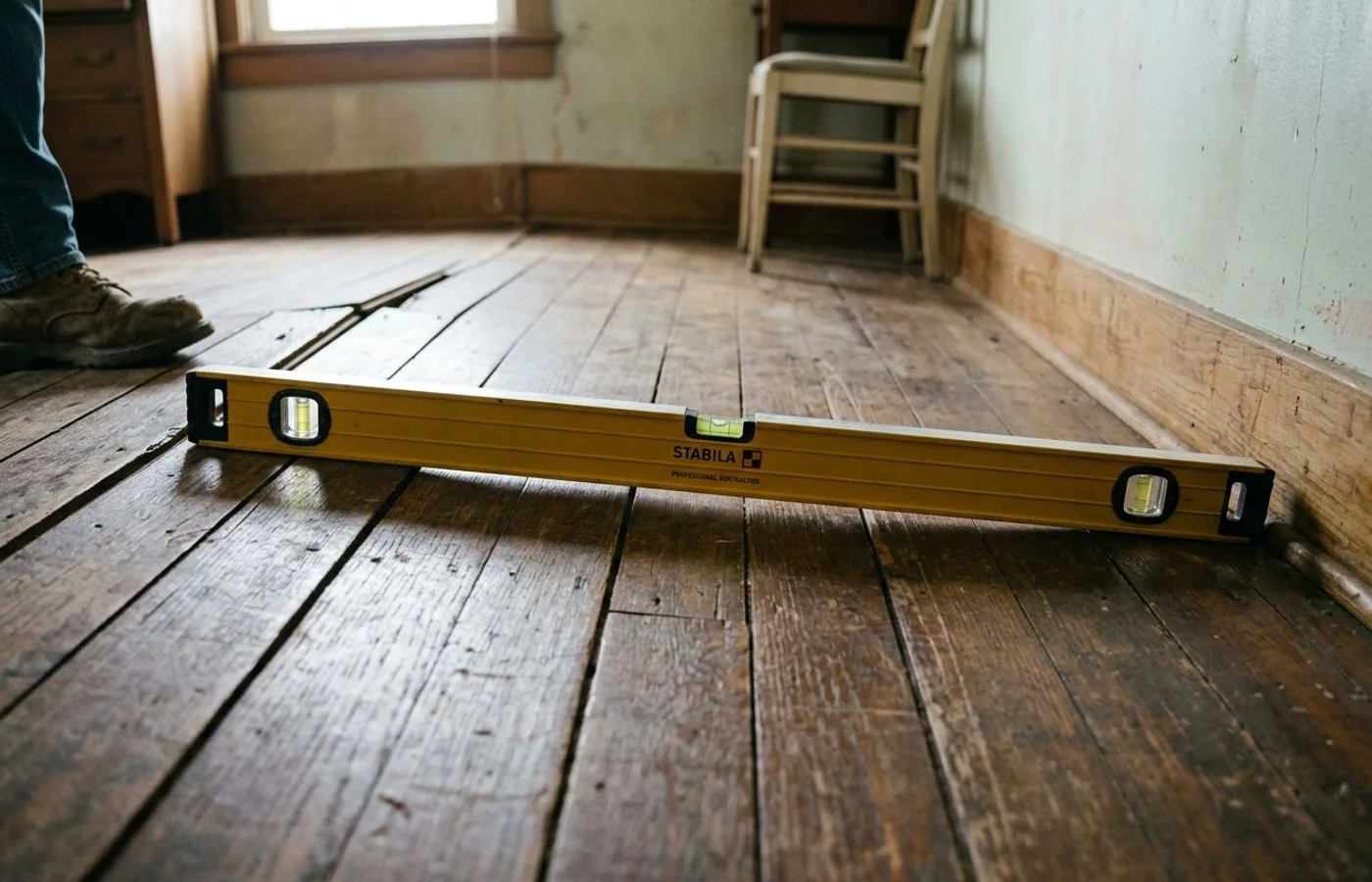
Kansas homes with a floor that slopes visibly in one direction usually have a structural footing that has dropped. You can actually feel it when walking across the room. Small slopes might be cosmetic settling from the original construction phase.
Slopes greater than about one inch across ten feet definitely warrant an inspection. We recommend using a standard four-foot carpenter’s level or conducting a simple marble test to confirm the tilt. This gives you a clear visual of exactly how far the floor has dropped.
Addressing the Slope
The repair approach depends entirely on what is causing the drop beneath the surface. Sinking interior floors over a crawl space often require new support jacks. If an entire concrete slab is sinking, contractors often use polyurethane foam injection to lift and level the floor.
Average concrete floor leveling projects in our region cost between $1,500 and $4,000 depending on the size of the void. Catching a dropping floor early allows for these less invasive lifting techniques. Waiting until the floor joists crack requires much more extensive framing repairs.
5. Gaps at trim, moulding, or between the house and the porch
Look closely at the joint between your crown moulding and the drywall. Check the space between your baseboards and the floor surface. A gap opening up in any of those places is a clear signal.
It means one part of the structure is moving separately from the other. We frequently find that exterior gaps are the first subtle warning signs homeowners notice. The space between the exterior porch or concrete steps and the house itself is a common failure point.
Gaps larger than a half-inch between a porch slab and the foundation wall indicate significant soil settlement. Heavy concrete steps sink faster than the actual house foundation when the soil washes out beneath them.
| Gap Location | What to Look For | Potential Meaning |
|---|---|---|
| Baseboards | Trim pulling up from the floor | Floor joists are sagging or dropping |
| Crown Moulding | Trim separating from the ceiling | Wall is bowing or dropping away from the roof |
| Exterior Porch | Concrete pulling away from brick | Soil erosion or settlement under the heavy slab |
| Window Trim | Caulk splitting at the edges | The window frame is racking out of square |
6. Horizontal cracks in basement walls
This situation is significantly more serious than most of the other warning signs. Horizontal cracks in a basement wall usually mean intense lateral pressure is pushing against your home. This pressure comes directly from expansive clay soils swelling with water outside the wall.
Hydrostatic pressure from wet soil can exert thousands of pounds of force per square foot against your basement walls. If the crack is wide or the wall is visibly bowing inward, it needs an inspection immediately. We see this happen frequently in south-central Kansas after heavy spring storms saturate the ground.
See our foundation crack repair guide for how we distinguish cosmetic surface cracks from deep structural failures.
Repair Options for Bowing Walls
A horizontal crack running the entire length of a wall is a red flag for structural failure. Engineers typically stabilize bowing walls using specialized wall anchors or carbon fiber straps.
- Carbon Fiber Straps: Applied flush to the wall to prevent any further inward movement.
- Steel Tiebacks (Deadman Anchors): Driven deep into the yard to pull the bowing wall outward.
- Wall Rebuilds: Required only if the concrete block has completely sheared off its base.
- I-Beam Braces: Steel beams anchored to the floor and ceiling joists for rigid support.
7. New water intrusion or damp spots
Foundation movement often opens up tiny hairline gaps that water always finds first. New seepage after a severe storm is a common indicator that the concrete has shifted. Damp spots in a basement corner or a sudden musty smell in a room that used to be dry are highly suspicious.
If waterproofing and drainage systems are already in place and they suddenly stop working, the structure likely moved. We know that a cracked foundation allows subsurface water to bypass your exterior barriers. Fixing the water issue often requires stabilizing the wall that shifted in the first place.
Many homeowners attempt to paint over wet spots with waterproof sealants. That approach only traps the moisture inside the concrete block itself. True repair requires addressing the external drainage and sealing the active structural crack. If water levels are high, installing a dedicated sump pump system in the Wichita area averages between $1,800 and $2,600.
Signs of Hidden Moisture
Water intrusion does not always look like a puddle on the floor. Pay attention to these secondary indicators of moisture penetration:
- White, chalky efflorescence powder forming on the basement walls.
- Rusty baseboards or rust spots on metal appliances resting on the floor.
- Peeling paint or bubbling wallpaper near the bottom of finished basement walls.
- An increase in household pests drawn to the damp, dark environment.
Why these signs escalate in Kansas
Most Wichita metro homes sit on expansive Harney silt loam and related heavy clays. Harney silt loam is actually the official state soil of Kansas, and it is known for its extreme shrink-swell capacity. Those soils swell dramatically when wet and shrink tightly when dry.
This intense shrink-swell cycle stresses building foundations twice a year. What looks like a slow-moving problem in Denver can move meaningfully in a single Kansas season. We actively track the average foundation repair costs in our region to help homeowners prepare.
In 2026, standard structural repairs in the Wichita area typically range from $4,000 to $15,000. Catching movement early gives you highly affordable options to prevent that higher cost. These early, cost-effective interventions often include:
- Applying carbon fiber wall straps to halt inward bowing.
- Correcting exterior drainage and burying downspouts.
- Installing a small number of support piers under a settling corner.
- Polyurethane injection for minor slab leveling.
Waiting simply narrows the choice down to bigger, significantly more expensive excavation work.
When to call for a free inspection
Any two of the signs of foundation problems Wichita homeowners face, appearing in the same season, is a reasonable trigger for a free on-site look. Actual wall bowing, wide horizontal cracks, or a visible floor slope should be inspected even sooner. Delaying an inspection usually just allows the damage to multiply.
We do free on-site inspections across the Wichita metro area without a high-pressure sales pitch attached. If it is nothing to worry about, we say so and go on our way. If the issue is real, we tell you the absolute smallest fix that actually holds the structure securely.
Get in touch through our foundation repair service to schedule an evaluation or simply call (316) 613-4575.
Our team is ready to provide the clarity you need. Taking action today protects your biggest investment for tomorrow.